
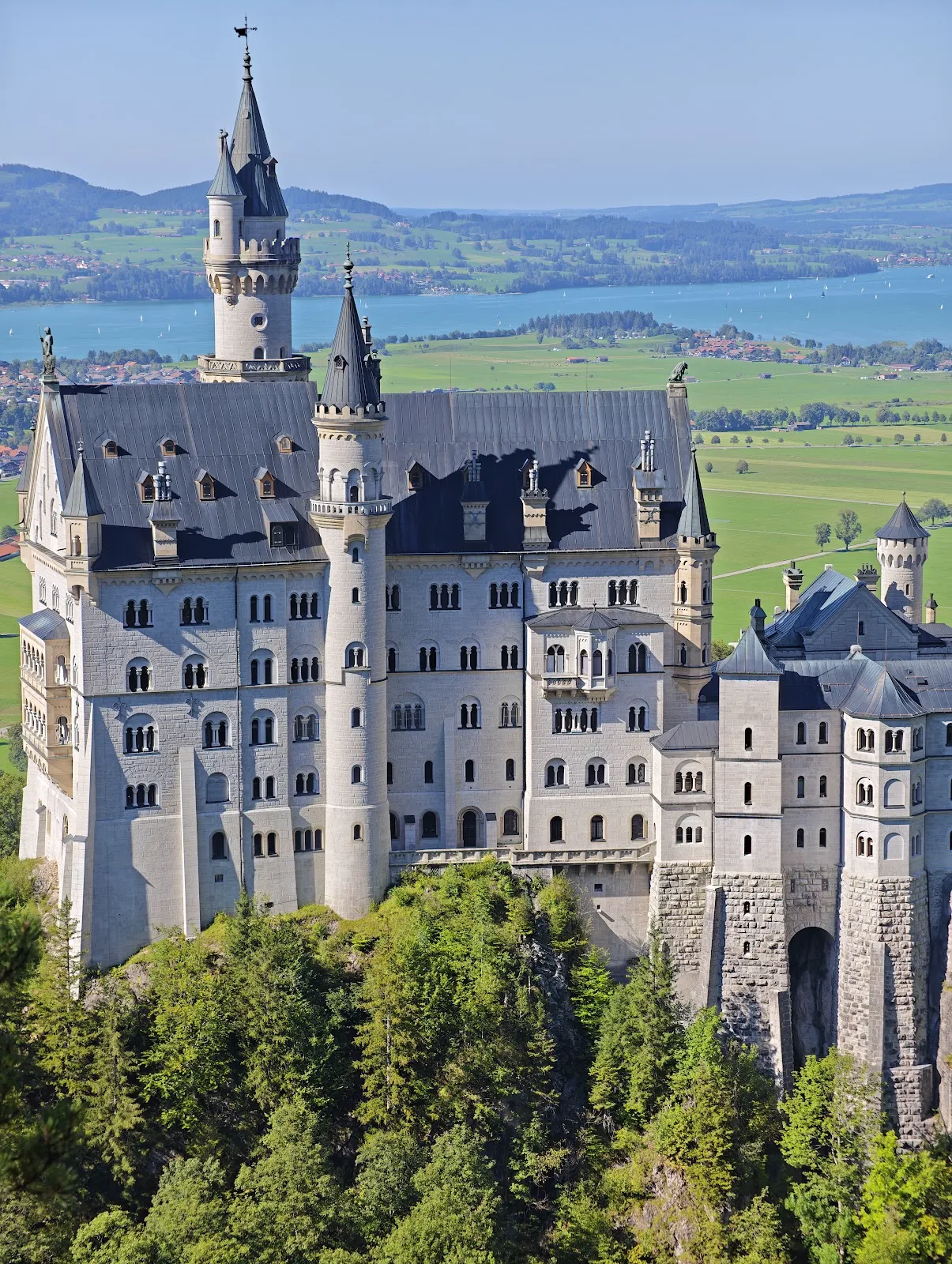
Rising from the forested cliffs above the village of Hohenschwangau, Neuschwanstein Castle stands as one of the most recognizable landmarks in Europe—a monument to artistic obsession, romantic nationalism, and the tortured genius of Bavaria's "Fairy Tale King." More than just a tourist destination, it represents the pinnacle of 19th-century romantic architecture and the dreams of a monarch who never saw it completed.
The Vision of a Lonely King
King Ludwig II of Bavaria (1845–1886) ascended to the throne at just 18 years old, inheriting a kingdom increasingly overshadowed by Prussian dominance. Rather than embrace the political realities of his era, Ludwig retreated into a world of art, music, and architecture. His obsession with the operas of Richard Wagner and the medieval German legends they celebrated would shape every stone of Neuschwanstein.
The castle was never intended as a seat of government or a fortress. It was designed as a private refuge— a stage set where Ludwig could live out his fantasies of medieval kingship, surrounded by murals depicting the characters from Wagner's operas: Tannhäuser, Lohengrin, Parsifal, and Tristan und Isolde.
It is my intention to rebuild the old castle ruin of Hohenschwangau near the Pöllat Gorge in the authentic style of the old German knights' castles.
— King Ludwig II, in a letter to Richard Wagner, 1868Architecture: A Romanesque Revival Masterpiece
Despite its medieval appearance, Neuschwanstein is a thoroughly modern creation. The castle was designed by Christian Jank, a theatrical set designer, rather than a traditional architect—a choice that explains its dramatic, almost fantastical silhouette. The architectural execution was handled by Eduard Riedel and later Georg von Dollmann.
The style is often described as Romanesque Revival, drawing inspiration from the Wartburg in Thuringia, a castle associated with the medieval Minnesingers (courtly love poets) and the legendary singing contest that inspired Wagner's "Tannhäuser." However, Neuschwanstein incorporates Gothic and Byzantine elements as well, creating an eclectic fusion that exists outside any strict historical period.
Throne Hall
A two-story Byzantine-style hall modeled after Hagia Sophia, though the throne itself was never installed before Ludwig's death.
Singer's Hall
The largest room in the castle, inspired by the legendary Great Hall of the Wartburg and the mythological worlds of Wagner's operas.
The Grotto
An artificial cave with stalactites and a small waterfall, recreating the Venusberg from Wagner's Tannhäuser.
Murals & Paintings
Over 200 painted scenes depict Wagner's operatic worlds and medieval German legends throughout the castle.
Modern Technology Behind Medieval Walls
While Neuschwanstein looks ancient, it was built using cutting-edge 19th-century technology. The castle features central heating powered by warm air from a basement furnace, running water on all floors (including hot water in the kitchen), flush toilets, and an elaborate system of electric bells for summoning servants. The kitchen even included a state-of-the-art rotisserie that could automatically adjust its speed based on the heat of the fire.
The construction employed scaffolding cranes and steam-powered machinery. The white limestone facade was quarried from nearby Alterschrofen, while the red brick interior walls represent millions of individual bricks transported up the steep mountainside by a specially constructed road.
A Castle Never Completed
Ludwig lived in Neuschwanstein for only 172 days before his mysterious death in 1886. At that time, only about one-third of the planned interior spaces had been finished. The castle was intended to include a chapel, a massive keep tower 90 meters high, and elaborate gardens—none of which were ever built.
The Hohenschwangau Connection
Neuschwanstein's location is no accident. It stands directly across the valley from Hohenschwangau Castle, Ludwig's childhood home, where his father Maximilian II had instilled in him a love of German medieval legends through the castle's romantic murals. Ludwig grew up gazing at the ruins of the medieval fortress that once stood on the site of Neuschwanstein—and spent 17 years rebuilding it as his own interpretation of that lost world.
The surrounding landscape of the Schwangau region—with its dramatic Alpine peaks, pristine lakes (the Alpsee and Schwansee), and deep forests—provided the perfect stage for Ludwig's vision. The famous Marienbrücke (Mary's Bridge), spanning the Pöllat Gorge, offers the iconic photograph angle that has made the castle world-famous.
Quick Facts
The Disney Connection
Neuschwanstein's silhouette has become the universal symbol of the fairy-tale castle. Walt Disney visited the castle in the 1950s and was so captivated by its romantic profile that it became the direct inspiration for Sleeping Beauty Castle at Disneyland (1955), which in turn influenced Cinderella Castle at Walt Disney World. The castle has appeared in countless films, from "Chitty Chitty Bang Bang" to "The Great Escape."
This global recognition has made Neuschwanstein Germany's most-visited tourist attraction, welcoming visitors from every continent who come to experience the fairy tale in person. Yet for all its fame, the castle remains a melancholy monument—a dream palace built by a king who sought escape from reality, and who would die before seeing his vision complete.
Tips for Travelers
Practical advice from visitors and local experts to help you plan your visit.
Book Tickets in Advance
Tickets sell out weeks ahead during peak season (June–September). Book online at hohenschwangau.de—walk-up tickets are rarely available. Your ticket has an exact entry time; late arrivals forfeit their slot.
Getting There from Munich
Take the train to Füssen (2 hours), then bus #73 or #78 to Hohenschwangau (10 min). Budget 55–75 minutes total from Füssen station to the castle gate, including the steep uphill walk or shuttle.
Bring Cash
The shuttle bus, horse carriages, and many parking machines are cash-only. The Bayern-Ticket covers trains and buses but not the castle shuttle. Bring at least €15–20 in small bills and coins.
The Iconic Photo Spot
The famous Marienbrücke bridge offers the classic view but gets crowded. For fewer tourists, continue up the trail toward Tegelberg for 10–15 minutes to find elevated viewpoints with the Alps in the background.
Visit Schwansee Lake
Skip the busy Alpsee and walk 15 minutes to Schwansee—a nature reserve with fewer crowds, warmer water for swimming, and views of both castles reflected in the lake.
Combine with Hohenschwangau
Ludwig's childhood home sits directly across the valley. Combo tickets are available, and the yellow castle offers insight into the origins of Ludwig's romantic obsessions.