
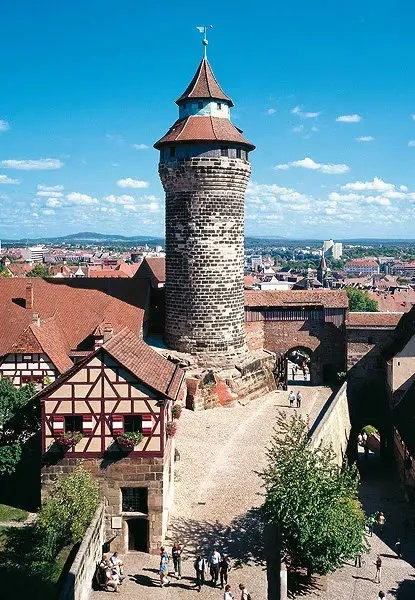
Between 1050 and 1571, every Emperor of the Holy Roman Empire—from Henry III to Maximilian II—held court within these sandstone walls. This was never a permanent residence; it was a Pfalz, a command center where itinerant rulers projected power across their fragmented empire.
A Castle in Three Parts
What appears as a unified fortress is actually three distinct historical zones: the Imperial Castle (Kaiserburg), the Burgraves' Castle (Burggrafenburg), and the Municipal Buildings—each with different origins, rulers, and modern access protocols. Understanding this division explains why visiting involves navigating three separate logics.
The Imperial Castle proper holds the main attractions: the Palas with its "Emperor – Empire – City" exhibition, the Romanesque Double Chapel, the 47-meter Deep Well, and the Sinwell Tower observation deck. The Burgraves' section survives largely as ruins—the Pentagonal Tower and Walburgis Chapel. The Municipal Buildings include what is now a youth hostel in the former Imperial Stables.
To understand why Europe looks the way it does, stand here where the Golden Bull was signed—this is where borders were drawn and dynasties legitimized.
— On the castle's political significanceArchitecture: Power Through Stone
This castle was not built for luxury—it was built for governance. Unlike the lavish Rococo palaces of Bavaria, Nuremberg's Imperial Castle is largely unfurnished. You come here for commanding views, Romanesque architecture, and 500 years of political history crystallized in sandstone, not gilded ceilings.
Double Chapel
A two-level Romanesque chapel—lower level for courtiers, upper level for the Emperor alone, connected directly to his apartments.
Deep Well (Tiefer Brunnen)
A 47-meter shaft cut through solid rock. Guided tours every 30 minutes demonstrate its depth with candles and water.
Sinwell Tower
The "perfectly round" keep offers 360° views of Nuremberg—the only observation point that shows the entire medieval city.
Castle Gardens
The Burggarten offers free access, terraced views, and the only green space at this elevation—a 90% view for zero cost.
The Adlerparkhaus View Hack
Everyone photographs the city FROM the castle. The superior shot is OF the castle, from the Adlerparkhaus rooftop. Take the elevator to the top deck of this parking garage for a panoramic view that includes the castle in the skyline—the Instagram angle most tourists never find.
Quick Facts
Tips for Travelers
Conquering the cobblestones and maximizing imperial history.
The Cobblestone Factor
The uphill walk from the Old Town is brutal on wheeled luggage. Cobblestones increase time by 30-50%, and the gradient averages 4-8%. Take Tram 4 to Tiergärtnertor to skip the steepest climb.
90% View for Free
The courtyards, castle gardens, and Freiung platform offer most of the visual experience without a ticket. Museum tickets are for history buffs; casual visitors can see the view and exterior free.
TagesTicket Plus Weekend Hack
Buy the VGN "TagesTicket Plus" on Saturday—it's valid for up to 6 people all weekend for ~€14. Massive savings for families across all Nuremberg transit.
Tower Closes for Ice
The Sinwell Tower closes when ice forms on the observation deck. Winter visits are hit-or-miss. Castle gardens also close at dusk and may close entirely in winter.
Skip Röslein, Find Gulden Stern
The "world's largest bratwurst restaurant" is a tourist machine. Zum Gulden Stern (1419) grills over beechwood fire—that smoky flavor is what you came for.
Go Underground Too
Beneath the castle lies the Felsengänge—medieval beer cellars that became WWII shelters. Guided tours add a vertical dimension to your visit.